

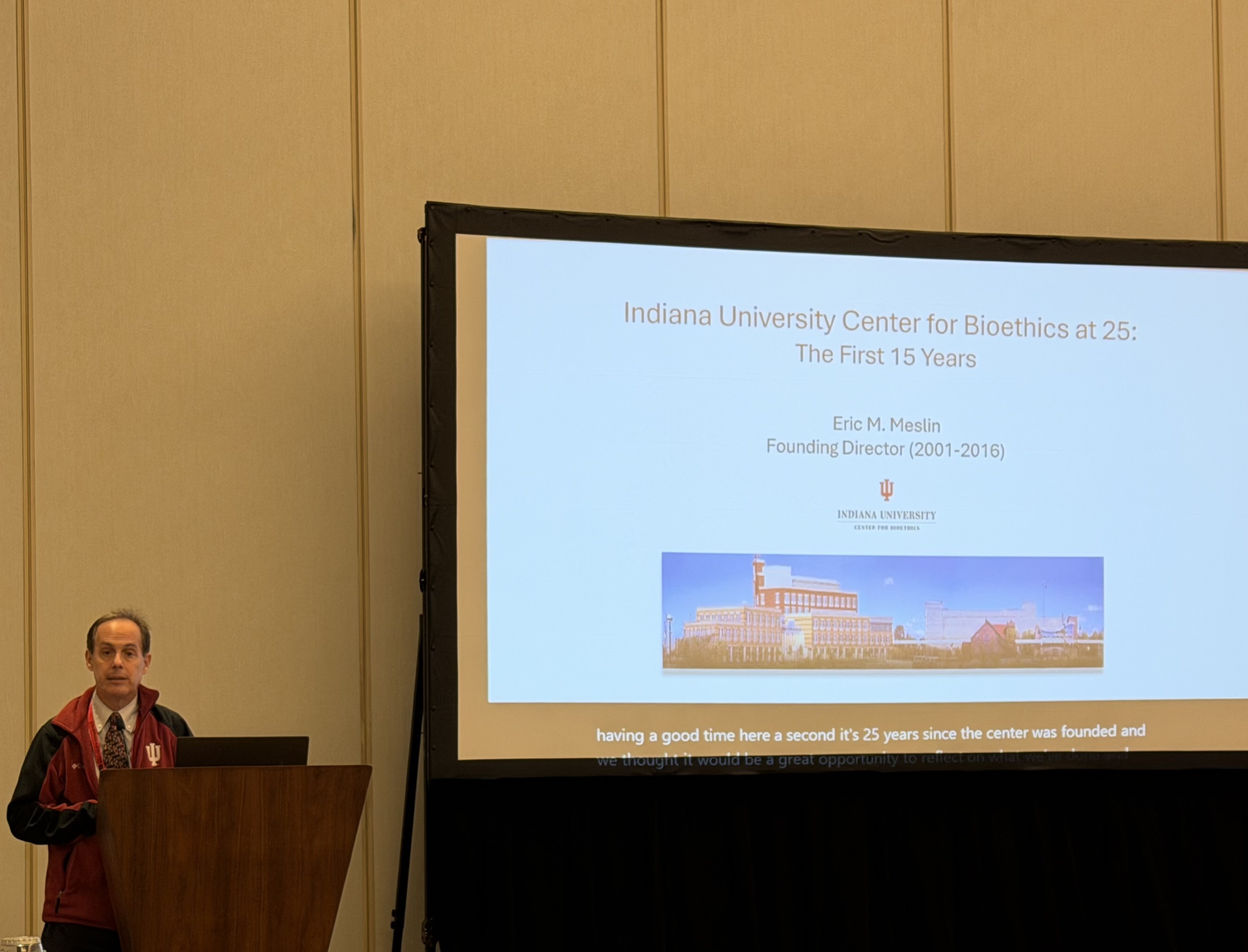
Last month the American Society for Bioethics and Humanities (ASBH) hosted their annual conference here in downtown Indy. The IUCB was well represented across all three days of the conference, with a number of both faculty and staff having the opportunity to present their work to peers from across the country. Panels and presentations included:
- Peter Schwartz, Colin Halverson, and Eric Meslin, "The Indiana University Center for Bioethics Turns 25: Considering the Past, Present, and Future of Our Field"
- 2026 marks the 25th anniversary of the founding of the Indiana University Center for Bioethics (IUCB), a milestone that provides an opportunity to reflect on the past, consider the present, and plan the future. The last 25 years have brought astonishing medical advances and demanding ethical challenges. From the shift to electronic health records, to the growth of genetic and personalized medicine, to the horrific COVID-19 pandemic, and now the rise of AI, the landscape has been constantly changing. Through it all, the IUCB, like others in our field, has analyzed and addressed these changes: developing a broad, funded research portfolio, providing compelling bioethics education, and informing and engaging the community across Indiana University and beyond.In this panel, speakers who study shared decision-making in a range of settings, using a range of disciplinary approaches, will present new models for determining when SDM is appropriate, what it should entail, and why it should be done.
- Seamus Donahue, "Just Say No to AI"
- As AI explodes onto the scene of healthcare, research, and seemingly every other facet of life, important ethical concerns have come with it. These concerns have inspired countless papers about what the ethical use of AI in healthcare and research should look like, ranging from conceptual analyses of authorship, surveys of patient perspectives, empirical studies of biases, etc. However, as bioethicists race to get in on the AI frenzy and publish papers on how to use AI ethically in healthcare, a fundamental question has been ignored: can AI use in healthcare ever be ethical? In this paper I will argue that this question should not be ignored, and more importantly that the answer is a resounding no. Using a rough form of utilitarian calculus, I will show that the public health risks of normalizing AI are too high with key risks-such as contributing to the misinformation epidemic, destroying critical thinking skills, and, perhaps most importantly, destroying the climate-clearly outweighing the potential benefits.
- Peter Schwartz, Josh Rager, and Justin Clapp, "Shared Decision Making: When and Why"
- When is shared decision making (SDM) appropriate in medicine and why should it be used? Modern bioethics has a standard answer: SDM is appropriate for all medical decisions, and the goal of SDM is for the patient's values and goals to guide their healthcare. Both these answers have been deeply undermined in recent years. Some bioethicists have argued that shorter conversations ("simple consent") may be appropriate at times, such as when there is a strongly recommended medical option (e.g. antibiotics for pneumonia in an otherwise healthy person). Similarly, bioethicists have questioned the US Department of Health and Human Services' recent guidance that recommended childhood vaccines should be given only after SDM.
- Amber Comer, "Life Unworthy of Life: Professional Reorientation and the Object of Protection in Nazi Medicine"
- Dominant accounts of physician participation in Nazi medicine emphasize bureaucratic distance, diffusion of responsibility, or authoritarian obedience. This paper argues that the decisive transformation was one of moral realignment rather than moral collapse. Nazi physicians did not abandon medical ethics; they reoriented them by redefining who counted as a patient, and thus whose life fell within the scope of medical protection. By shifting the locus of care from the individual to the Volkskörper, the imagined biological body of the nation, physicians preserved internally coherent ethical reasoning, intact professional identity, and persistent moral language while systematically excluding certain lives from protection entirely.
- David Craig, "Caring for Medicaid: Prioritizing Health-Seeker Agency over Autonomy"
- Compared to Medicare, many Americans view Medicaid as lesser care for less deserving people, particularly "able-bodied adults" on Medicaid Expansion plans. This moral hierarchy-between caring for seniors who worked a lifetime and aiding low-income people who are presumed not to work-was used to justify the Big Beautiful Bill's $900+ billion in Medicaid cuts. Half of those cuts will come from disenrolling millions through work requirements and frequent eligibility reviews now being imposed on all the states. Indiana's Medicaid Expansion, the Healthy Indiana Plan (HIP), pioneered "personal responsibility" provisions in Medicaid. Our team conducted RWJF-funded Community Valued Research, interviewing 100 HIP members and convening community health equity consultations co-designed with a Community Leadership Board. Learning from these community experts, we co-developed a greater understanding of health-seeker agency that, we argue, should be prioritized in health policy over the narrow choice-based idea of autonomy that predominates in bioethics.
- Peter Schwartz, Colin Halverson, Amy Waltz, and Andrew Saykin, "Should a Healthy Research Participant be Told that their Brain Imaging and Biomarkers Show High Risk for Alzheimer’s Disease?"
- Currently, there are no approved treatments for those who do not have Alzheimer's or Mild Cognitive Impairment, often a prodromal stage of Alzheimer's. But healthy participants often ask for their results, and some ADRCs are disclosing them to patients who request those results. One argument for disclosure is that, although there are no approved preventive treatments, there are trials studying the effectiveness that someone at high risk might seek out. In this Debate, the director of an ADRC will describe a case of a healthy participant whose testing indicates high risk for Alzheimer's, in particular atrophy seen on MRI and abnormal p-tau217. One discussant will argue for disclosing these results to the participant, if the participant wishes, and the second discussant will argue against offering them. Our final discussant will describe regulatory issues governing the possible return of results in a case such as this.
- David Craig, Tracey Hutchings-Goetz, Ira Mallory, Ivan Douglas Hicks "Amplifying Community Voices in Health Policy: Strategic Uses of Public Humanities by All Means Available"
- For nearly a decade, a community-university partnership has developed strategies for creative research and dissemination aimed at amplifying community voices for real-world impact and improved quality of life for all. Together, community members, leaders, and organizers, scholar activists, and artistic creatives have demonstrated how lived experience, credible data, and moral conviction can combine to influence the direction of state and national policy, particularly around Medicaid. Our panel offers scholars new strategies and tactics for influencing public policy at a time when health equity has been systematically rejected as a policy goal.
To celebrate a successful ASBH conference, IUCB faculty and staff who presented or participated in ASBH will be writing a series of blog posts for the IU Bioethics Blog to talk about their own presentation or a session that interested them. You can keep up with that blog series by keeping an eye out for new posts here.
In addition, we’ll be hosting a version of our 25th anniversary panel, "The Indiana University Center for Bioethics Turns 25: Considering the Past, Present, and Future of Our Field,” on Thursday, November 12, at noon for IU community members that were not at ASBH. You can find more info on the panel here.